

You walk into your office and the temperature feels fine, but something is off. The air feels heavy, stale, maybe even suffocating by mid-afternoon. The HVAC system is running, yet the discomfort lingers.
Harold Brothers has helped hundreds of facility managers and commercial tenants resolve this exact issue without replacing equipment or overhauling their entire HVAC system. The real culprit is often ventilation, not heating or cooling.
In this article, you’ll learn why a running HVAC system doesn't always mean good air quality, how poor ventilation causes that stuffy feeling, and what steps you can take to fix it using the system you already have.
Why Running HVAC Does Not Always Mean Fresh Air
Most commercial HVAC systems are designed to recirculate indoor air. This helps control temperature efficiently and reduces energy costs. Fresh outdoor air is mixed in based on set limits, schedules, and control logic.
The problem is that air can move without being refreshed. In many buildings, this comes down to how economizers are set up, since they control when and how much outdoor air the system is allowed to bring in.
If outdoor air intake is limited, the system keeps reheating or cooling the same indoor air throughout the day. As people breathe, carbon dioxide levels rise. Office equipment, furniture, and cleaning products release small amounts of contaminants. Without enough outdoor air to dilute them, the space begins to feel stale.
From the system’s point of view, everything is working. From the occupant’s point of view, the air feels heavy.

What People Usually Mean When They Say the Air Feels “Stuffy”
Most occupants do not talk about ventilation rates or carbon dioxide levels. They describe how the space feels.
Common comments include:
- The air feels thick or heavy
- I feel tired in the afternoon
- It smells stale, but not bad
- The room feels uncomfortable even though the temperature is fine
These types of complaints are often early indicators that commercial building maintenance practices are not keeping up with how the space is being used.
Why Stuffy Air Often Gets Worse as the Day Goes On
Many offices feel acceptable in the morning and noticeably worse by midday or afternoon. This is not a coincidence.
As the day progresses, more people arrive, meetings begin, and equipment runs continuously. Each person adds carbon dioxide to the space. If ventilation does not increase to match occupancy, indoor air quality slowly declines. This is one reason preventative maintenance plays a role in indoor air quality, even when heating and cooling equipment appears to be operating normally.
By the time people start complaining, the issue has been building for hours. Adjusting the thermostat at that point does very little, because temperature is not the root cause.
How HVAC Controls Quietly Create Stale Air Problems
One of the biggest reasons stuffy air goes unresolved is because the controls are technically working.
Outdoor air dampers may be intentionally limited to save energy. Schedules may be set for older occupancy patterns. Economizers may be disabled or using the wrong logic. Sensors may be out of calibration.
None of these issues cause the system to shut down. No alarms go off. Maintenance checks may pass. But comfort slowly degrades.
This is why stuffy air problems often linger for months or even years.
How Filters and Airflow Distribution Play a Role
Even when ventilation rates are correct, air still needs to reach occupied spaces.
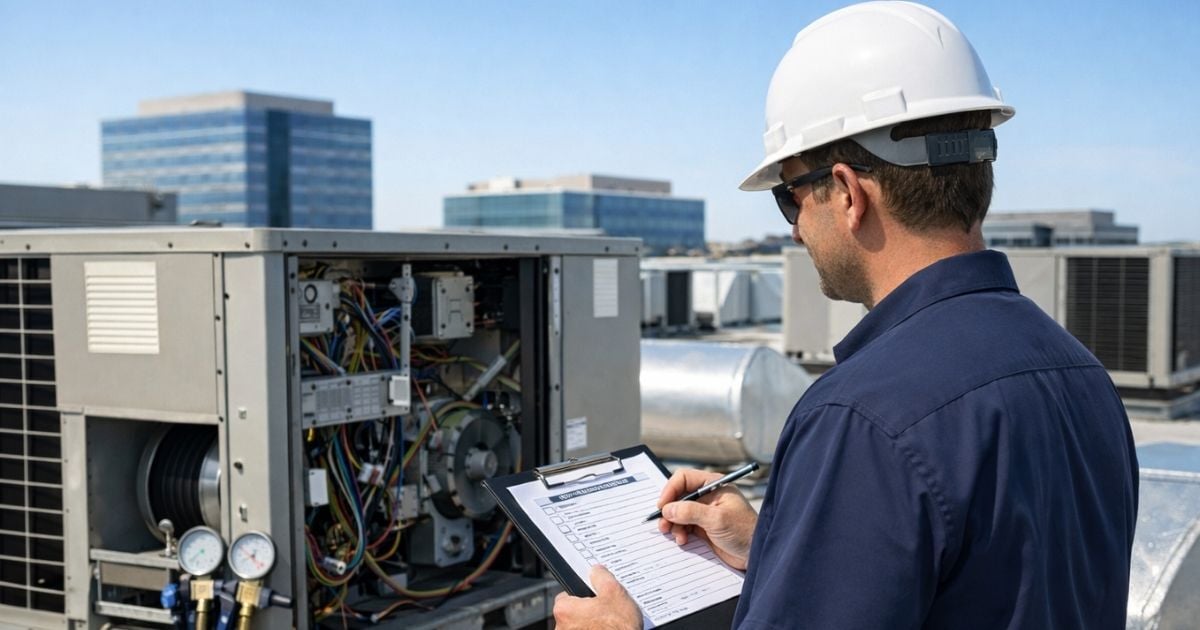
Dirty filters restrict airflow. Blocked diffusers and closed dampers prevent fresh air from reaching certain rooms. Poor return air paths can trap stale air in conference rooms or interior offices. These are the kinds of airflow and filtration issues that are normally reviewed when looking at what is included in a commercial HVAC preventative maintenance contract.
This is why one area of the building can feel fine while another feels unbearable, even though they are on the same system.
Why Spring and Fall Make the Problem More Noticeable
Stuffy air complaints spike in spring and fall for a reason.
These are the shoulder seasons, when outdoor temperatures are mild and humidity changes quickly. During these times, economizers should be bringing in more outdoor air to improve comfort and reduce cooling demand.
If economizer controls are misapplied or disabled, the system may avoid outdoor air when it would help the most. The building misses a key opportunity to flush out stale air.
This is often when occupants notice that the building feels uncomfortable, even though energy use looks normal. When ventilation is limited during these seasons, systems often run longer than necessary, trying to correct comfort complaints.
|
What You Feel in the Office |
What Is Happening Behind the Scenes |
|
Air feels stale or heavy |
Outdoor air intake is limited |
|
Afternoon fatigue |
CO₂ levels rise as occupancy increases |
|
Thermostat adjustments do not help |
Temperature control is working, ventilation is not |
|
Worse in spring and fall |
Economizer is not using outdoor air effectively |
|
Some rooms feel worse than others |
Airflow distribution is uneven |
This is why stuffy air is rarely fixed by changing temperature setpoints or replacing equipment.
How Air Quality Is Fixed Without New Equipment
In most commercial offices, solving a stuffy air problem does not require replacing HVAC units.
The solution usually involves:
- Verifying outdoor air damper operation
- Reviewing schedules and control sequences
- Checking airflow balance and distribution
- Evaluating carbon dioxide trends
- Correcting economizer logic
- Making small programming or software adjustments
These are control and ventilation improvements, not capital projects. When done correctly, they often improve comfort and reduce complaints without increasing energy costs.
These adjustments are typically made gradually, following what a preventative maintenance contract looks like over the year.
What to Do If Your Office Feels Stuffy in Mild Weather
A stuffy office is more than a nuisance. It’s a sign that your building's ventilation isn’t keeping up with the way the space is being used. Fortunately, the solution usually involves better control, not new equipment.
You came here wondering why your office feels stale even when the HVAC system is running. The answer often lies in how outdoor air is being managed and delivered to the space.
If your office feels worse during mild weather, your economizer settings could be limiting the fresh air your building needs. Read more about your Air Side Economizer, and how its set up can affect your indoor air quality.
At Harold Brothers, we help building managers diagnose and resolve indoor air quality problems using their existing systems. If your space still doesn’t feel right, we’re ready to help you find the source and fix it.

Topics: